Who is behind this company, and is it still standing?
i
The ordinary company report from the Italian Business Register (Registro imprese): registered office, directors, signing powers, shareholders and proceedings under way. Usually ready in a few minutes · you pay at checkout, then we fetch it.Grátis nos leilões
If the company is selling a lot at auction
Who is selling, under which procedure and for how long: you can read it on the lot page without asking for anything, and it is often enough to understand who you are dealing with.
See the auctions →Em resumo
A visura camerale é a carteira de identidade de uma empresa: sede, forma jurídica, capital social, administradores e seus poderes, atividade, sócios e eventuais processos em andamento. Ela é emitida pelo registro de empresas (Registro delle imprese) mantido pelas câmaras de comércio, e qualquer pessoa pode pedir.
O documento em resumo
How to read a visura camerale
There are seven things to look at, and the first three are nearly always enough to decide whether to go on. On the figure each one has its number.
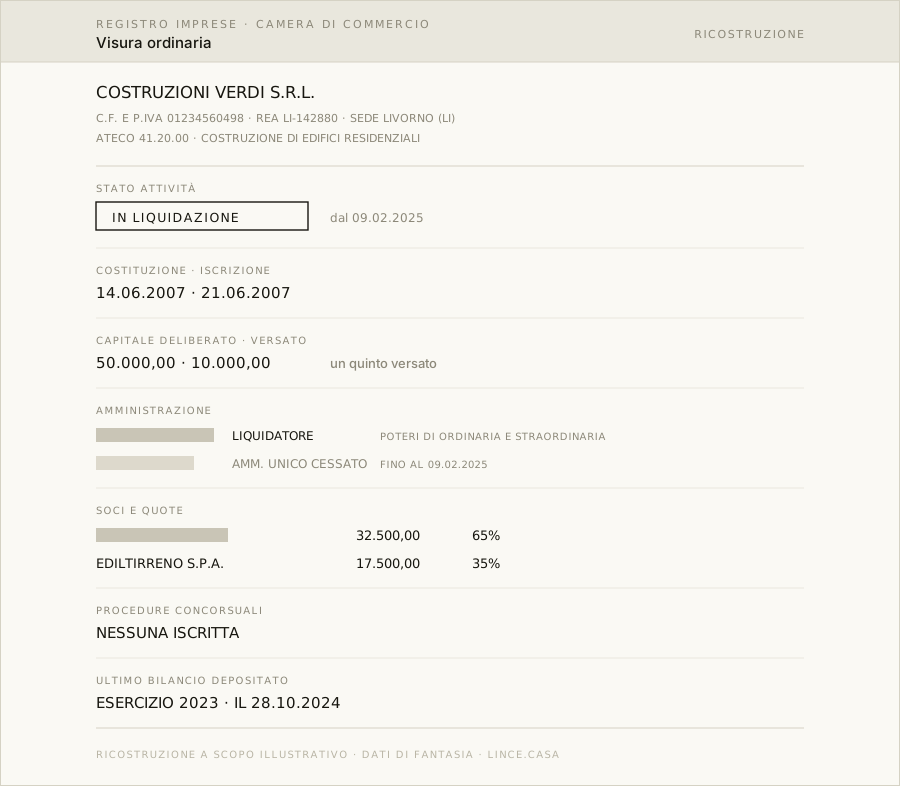
Role a figura para ler os detalhes →
- 1The status of the business. Active, inactive, in liquidation, ceased. It is the first thing to look at if this company is selling you something.
- 2How long it has existed. A company incorporated last month that sells property is a different thing from one dating from 2007.
- 3Authorised and paid-up capital. What counts is the money paid in, not the money announced: it is the measure of how far the company is liable.
- 4Who can sign. The name is not enough: the powers count. A preliminary contract signed by someone without them is a problem discovered at the notary's.
- 5Shareholders and shares. In S.r.l. companies the shareholders are public. In S.p.A. companies they are not: there the extract stops short.
- 6Insolvency proceedings. Bankruptcy, composition with creditors, judicial liquidation.
- 7The latest filed accounts. If the latest are three years old, it is a signal, not proof.
Ordinary, historical, artisan
The ordinary extract (ordinaria) is today's snapshot and is the one usually needed. The historical one (storica) adds every change over time: changes of registered office, of director, of shareholders, and it is the one to ask for when the question is “how long has it been like this”. The artisan one (artigiana) concerns businesses entered in the register of artisans and adds the details of that entry.
If there is a procedure on the other side
In court sales the seller is almost never the business itself: it is the procedure, through a delegate or a trustee (curatore). The extract is still useful, and useful earlier: it says whether the company registered as owner is still active, who represents it and since when it has been in liquidation.
O documento seguinte
Continue daqui
Encontre o seu município
Custos, canais e requisitos de acesso são procedimentos do órgão que emite o documento, verificados na fonte em 28 de julho de 2026. Antes de agir, confira no site do órgão.