Who is behind this company, and is it still standing?
i
The ordinary company report from the Italian Business Register (Registro imprese): registered office, directors, signing powers, shareholders and proceedings under way. Usually ready in a few minutes · you pay at checkout, then we fetch it.Kostenlos, bei den Versteigerungen
If the company is selling a lot at auction
Who is selling, under which procedure and for how long: you can read it on the lot page without asking for anything, and it is often enough to understand who you are dealing with.
See the auctions →Kurz gesagt
Die visura camerale ist der Ausweis eines Unternehmens: Sitz, Rechtsform, Stammkapital, Geschäftsführer und ihre Befugnisse, Tätigkeit, Gesellschafter und etwaige laufende Verfahren. Sie stammt aus dem Handelsregister (Registro delle imprese) der Handelskammern, und jeder kann sie beantragen.
Das Dokument auf einen Blick
How to read a visura camerale
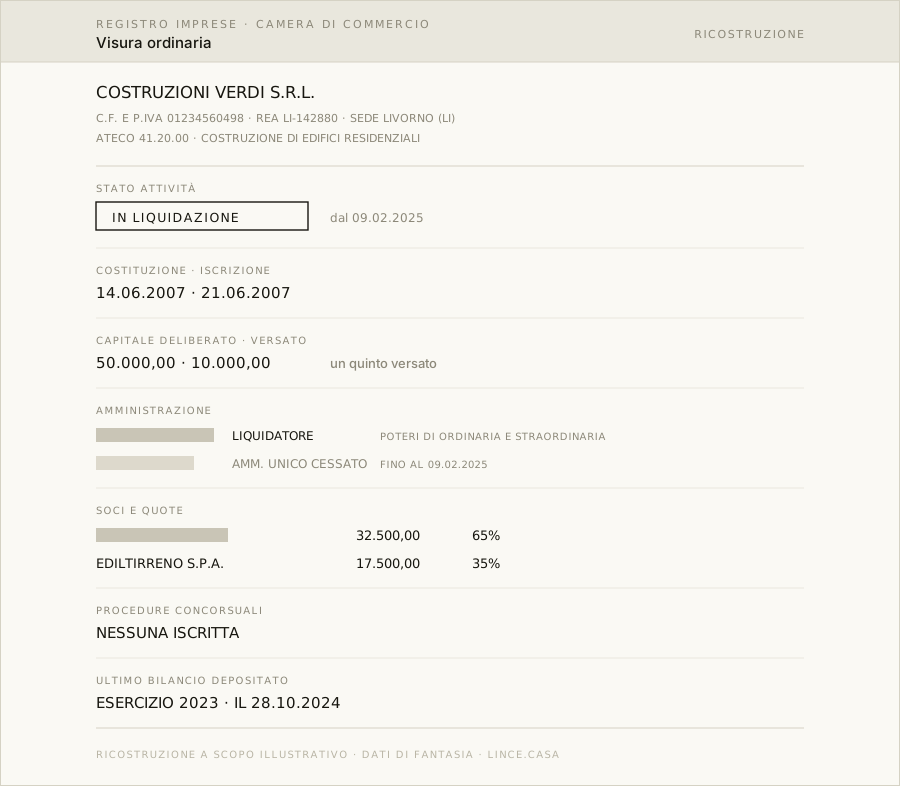
There are seven things to look at, and the first three are nearly always enough to decide whether to go on. On the figure each one has its number.
Wischen Sie über die Abbildung, um die Details zu lesen →
- 1The status of the business. Active, inactive, in liquidation, ceased. It is the first thing to look at if this company is selling you something.
- 2How long it has existed. A company incorporated last month that sells property is a different thing from one dating from 2007.
- 3Authorised and paid-up capital. What counts is the money paid in, not the money announced: it is the measure of how far the company is liable.
- 4Who can sign. The name is not enough: the powers count. A preliminary contract signed by someone without them is a problem discovered at the notary's.
- 5Shareholders and shares. In S.r.l. companies the shareholders are public. In S.p.A. companies they are not: there the extract stops short.
- 6Insolvency proceedings. Bankruptcy, composition with creditors, judicial liquidation.
- 7The latest filed accounts. If the latest are three years old, it is a signal, not proof.
Ordinary, historical, artisan
The ordinary extract (ordinaria) is today's snapshot and is the one usually needed. The historical one (storica) adds every change over time: changes of registered office, of director, of shareholders, and it is the one to ask for when the question is “how long has it been like this”. The artisan one (artigiana) concerns businesses entered in the register of artisans and adds the details of that entry.
If there is a procedure on the other side
In court sales the seller is almost never the business itself: it is the procedure, through a delegate or a trustee (curatore). The extract is still useful, and useful earlier: it says whether the company registered as owner is still active, who represents it and since when it has been in liquidation.
Das Dokument danach
Von hier aus weiter
Ihre Gemeinde finden
Kosten, Wege und Zugangsvoraussetzungen sind Verfahren der Stelle, die das Dokument ausstellt. Wir haben sie am 28. Juli 2026 an der Quelle geprüft. Prüfen Sie vor jedem Schritt die Website der Stelle.