Are there mortgages or seizures?
i
The summary list of the entries on the property in the land registry (conservatoria). The full notes for the lines you care about are ordered afterwards, one by one, €14.90 each. Usually ready in a few minutes · you pay at checkout, then we request it from the land registry.Gratuit, sur les enchères
If the lot is at auction
The court publishes the appraisal, and it almost always contains the list of encumbrances. You find it here with the date of the next sale, for free.
See the auctions →En bref
L’ispezione ipotecaria (recherche hypothécaire) interroge les registres fonciers et indique ce qui grève un bien et qui l’a acheté ou vendu : hypothèques, saisies, ventes, donations, successions.
Le document en bref
How to read a mortgage search
The search does not answer yes or no: it hands you a list of entries (formalità) with codes. Below is the summary list, which is the one people really read, with the place where each of the things that matter is found.
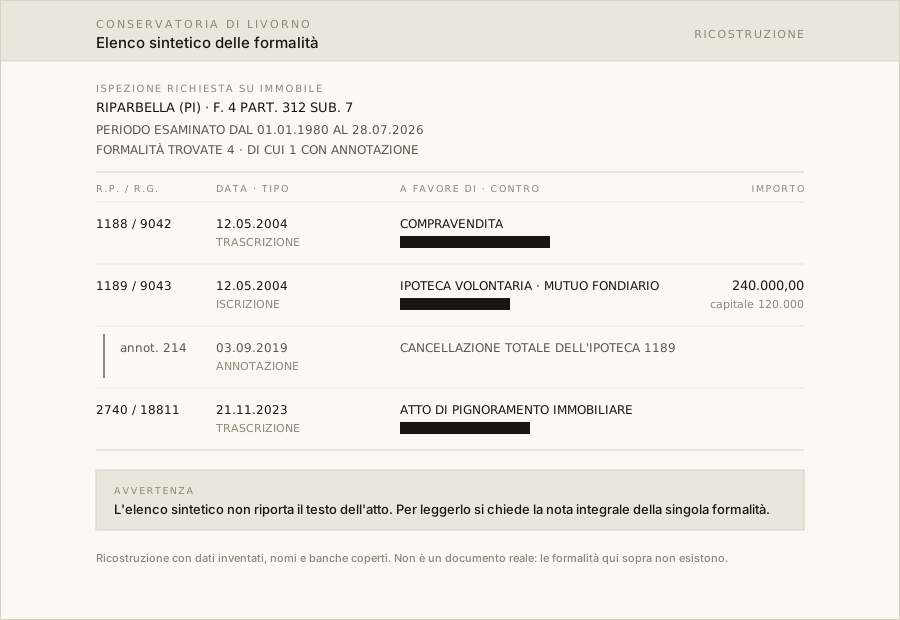
Faites défiler la figure pour lire les détails →
- 1What you asked and up to when. The search is on a property or on a person, and covers a period: outside that period it has not looked.
- 2Registro particolare and registro generale. The two numbers that identify the entry: you need them to request the full note for that line and no other.
- 3Trascrizione, iscrizione, annotazione. A transcription records a transfer, a registration places a mortgage, an annotation changes an earlier line.
- 4Type of deed and public official. They say it is a mortgage for a loan and who received it. The amount is not here: it is in the full note, and it is two or three times the loan, not what is owed today.
- 5The annotation of cancellation. This line extinguishes the mortgage above it. A mortgage without this line is still alive, even if the loan is finished.
- 6The seizure (pignoramento). From here on the property is under enforcement: it is the line that takes a property to auction, and it is nearly always the last one transcribed.
- 7What the list does not say. The content of the deed is in the full note, which is requested line by line.
If you are looking at an auction lot
In court auctions the charges are the question that matters, and much of the answer is already public: the valuation report (perizia) filed with the court lists them, and the transfer decree cancels the prejudicial registrations and transcriptions. In our auction reports that data has already been read from the court documents, together with the history of price reductions.
Le document suivant
Continuer à partir d’ici
Trouver votre commune
Les coûts, les canaux et les conditions d’accès relèvent des procédures de l’organisme qui délivre le document, vérifiées à la source le 28 juillet 2026. Avant d’agir, vérifiez sur le site de l’organisme.